
The Money Machine
Anthropic just became the most valuable startup on Earth. The way its money actually works is both the most bullish and the most unsettling thing about it.

Part 2 of a series on how Anthropic went from underdog to the most important company in AI. (Part 1, “All at One Company,” was about the team.)
Every month, Anthropic writes a check for $1.25 billion to Elon Musk.
Not to Elon personally — to xAI, his AI company, the one building Grok, a direct competitor to Claude. The deal, which only became public through SpaceX’s IPO filing, hands Anthropic the entire output of a data center called Colossus 1 near Memphis, runs through 2029, and could ultimately send xAI more than $40 billion.
Sit with the strangeness of that. The most safety-obsessed lab in AI is paying its loudest critic — a man who has sued OpenAI, feuded with half the industry, and competes with Claude head-on — more than a billion dollars a month just to rent the computers it needs to keep going. xAI, for its part, overbuilt its own capacity and watched usage of Grok slump, so it’s quietly selling the spare compute to a rival to make the math work. And the rivalry is about to get far more direct: xAI, now folded into SpaceX, has struck a deal to acquire Cursor — the AI-coding IDE that defined the category — for as much as $60 billion, aiming Musk squarely at the coding market Claude Code leads. Cursor was built on top of Claude; now it’s defecting to the competition. Which means Anthropic is, in a roundabout way, helping fund the company buying its rival.
That is the AI economy in 2026: so capital-hungry, so circular, and so enormous that yesterday’s enemies are today’s landlords. And nobody embodies it better than the company that just became the most valuable startup on the planet.
This is a piece about the money — where it comes from, where it goes, and why the same flywheel that makes Anthropic look unstoppable is the thing that should make you a little nervous.
The flip
Explore the interactive version →
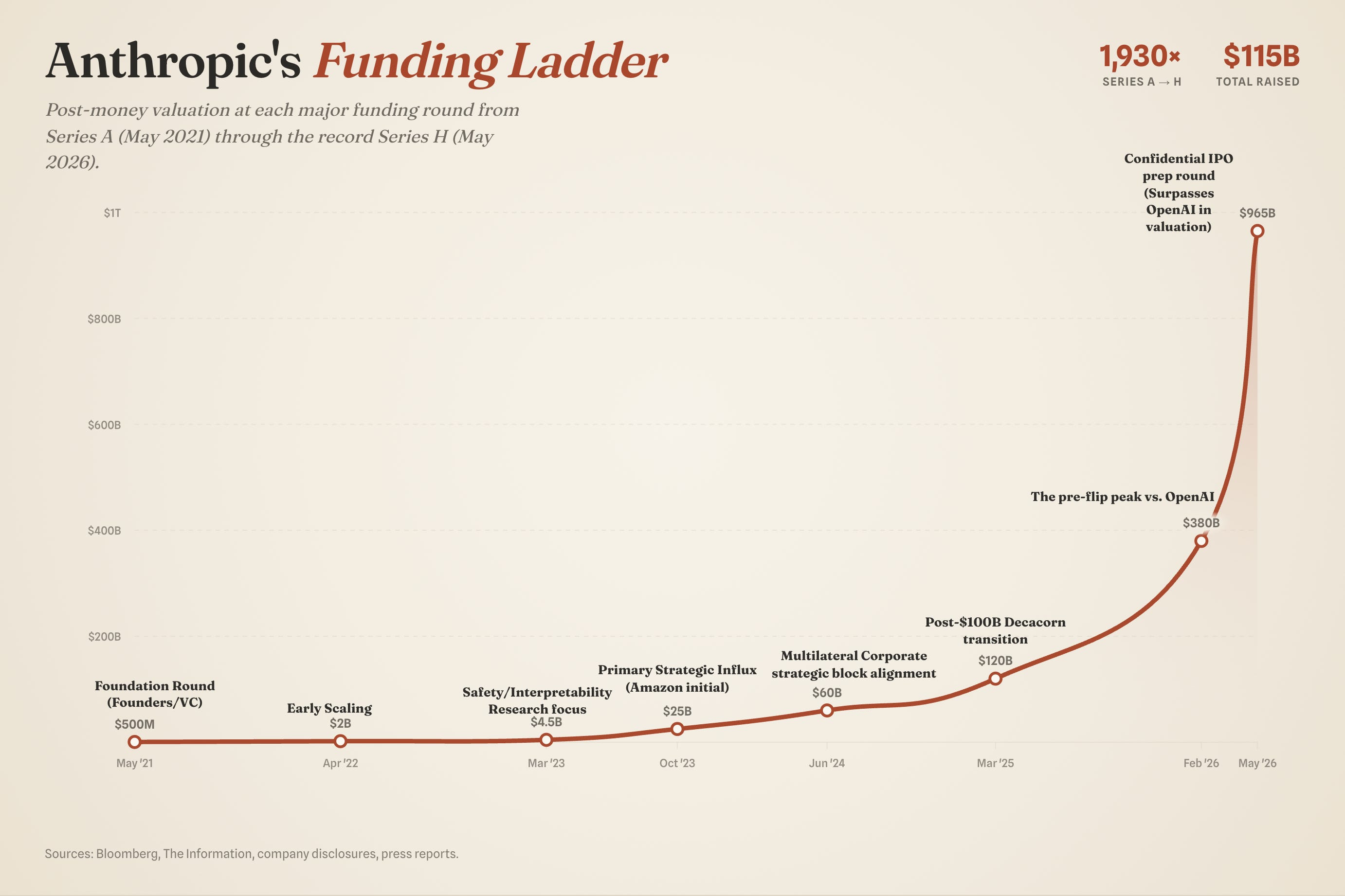
The headline is staggering on its own. In late May 2026, Anthropic raised $65 billion in a Series H round that valued it at $965 billion — within arm’s reach of a trillion dollars. The round nearly tripled its $380 billion valuation from February. That’s three months, and more than half a trillion dollars of new value. And it lifted Anthropic past OpenAI, last valued around $852 billion, to the top of the entire startup world.
The underdog won. Three years ago, Anthropic was the safety-obsessed spin-off almost nobody outside the field had heard of. Today it’s the most valuable private company on Earth.
And $965 billion may be the conservative number. In the secondary markets — where employees and early investors trade private shares — Anthropic has been changing hands higher. On Forge Global, the regulated marketplace, its shares have implied a valuation near $1 trillion, ahead of OpenAI on the same platform — an inversion that didn’t exist three months earlier. On-chain it got wilder still: a tokenized market on Solana implied as much as $1.2 to $1.4 trillion. One private company, four different prices, running 3–4x apart, every order book updating in real time.
That deserves a caveat, because it cuts against the hype as much as for it. Anthropic disavowed most of the on-chain frenzy: in May it declared any share transfer not approved by its board void, banned the tokenized SPVs outright, and named the platforms peddling them as unauthorized — and the tokens promptly fell about 40%. Those venues are thin (one implied a trillion-plus valuation while holding only ~$23 million in real assets), so the wildest figures are more narrative than net worth. But strip the froth away and the signal survives: in the places where real shares actually change hands, Anthropic is trading around a trillion dollars, ahead of OpenAI. The market isn’t waiting for the S-1 to tell you who’s winning.
The revenue is real
Explore the interactive version →
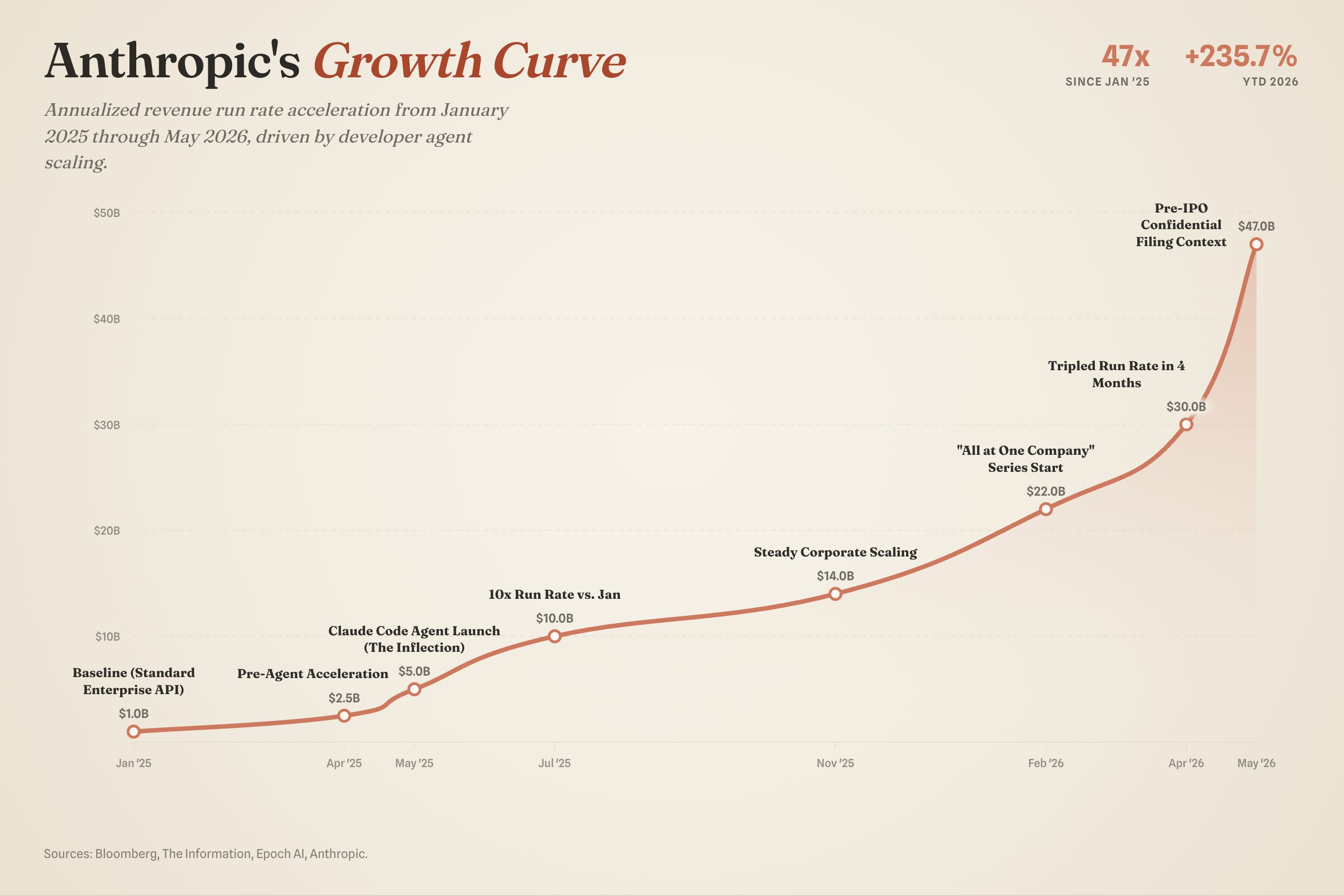
The valuation isn’t floating free of revenue, either. Anthropic’s annualized revenue run-rate hit roughly $47 billion by late May, up from $30 billion in April, $14 billion last November, and about $1 billion at the start of 2025. That’s more than 10x growth a year, three years running — a pace essentially no software company in history has matched. Salesforce took about two decades to reach $10 billion in annual revenue. Anthropic did the back half of that climb in a single quarter.
More telling than the totals is who’s paying. By Menlo Ventures’ enterprise survey, Anthropic now commands roughly 40% of enterprise spending on large language models, versus OpenAI’s 27% — a near-perfect inversion of 2023, when OpenAI had half the market and Anthropic barely registered. In the category that matters most — coding — Anthropic’s share is north of 50% to OpenAI’s ~21%. Eight of the Fortune 10 are Claude customers. OpenAI still dwarfs Anthropic in consumer reach, with hundreds of millions of weekly ChatGPT users, but in the enterprise — where the sticky, high-margin money lives — Anthropic quietly took the lead.
How the machine actually makes money
Most people still think “Claude” means a chatbot. Where the revenue is, it doesn’t.
The engine is Claude Code, Anthropic’s AI coding agent, launched in May 2025. By early 2026 it was generating around $2.5 billion on its own, up from $500 million the previous September. More importantly, it made Anthropic the thing developers build on — the API companies wire into their own products, plus the MCP protocol, now the de facto standard for wiring models into tools and data. (Part 1’s roster of CTOs-turned-ICs is partly explained right here: Anthropic is building the enterprise software layer, and it hired the people who know how to build it.)
The strategic choice underneath is the whole game. While OpenAI chased the consumer with ChatGPT, Anthropic went after the enterprise and the developer. Consumer AI is a brutal, low-margin popularity contest. Enterprise AI is sticky and compounding — and the lock-in runs deeper than it looks. Once a company builds on your model, it tunes everything around that specific model’s quirks: the prompts, the guardrails, the little workarounds for how it behaves. Switching providers isn’t swapping an API key — it means inheriting a different model’s quirks and risking regressions across a workflow you spent months optimizing. It isn’t even seamless within one provider: moving from, say, Claude Opus 4.7 to 4.8 can shift behavior in ways teams have to re-tune around, so “newer” isn’t automatically “drop-in better.” That friction is a moat — the cost of leaving compounds the longer you stay. Anthropic bet on the less glamorous customer, and that customer turned out to have far deeper pockets, and nowhere convenient to go.
Tokenmaxxing
Here’s where it gets fun, and a little unhinged.
When AI usage is metered by the “token,” and the models get good enough to be worth using constantly, companies start burning compute at a rate that breaks budgets. The industry even has a nickname for the behavior: tokenmaxxing.


The anecdotes are something. Uber reportedly burned through its entire 2026 budget for AI coding tools in four months. And then there’s Microsoft. Remember who Microsoft is in this story: OpenAI’s closest ally, with more than $13 billion invested and roughly a quarter of the company. Yet even Microsoft hedged toward Claude — it put $5 billion into Anthropic in late 2025, wired Claude into GitHub Copilot and Microsoft 365 Copilot, and handed its own engineers Claude Code to build with. Then the bills arrived. By mid-2026 Microsoft was canceling most of those Claude Code licenses and steering people back to its cheaper in-house tool, after usage blew past what the finance side had forecast. As one Nvidia executive put it, in a line that captures the entire era, the cost of compute had grown “far beyond the costs of the employees.”
When even OpenAI’s biggest backer is paying to let its people use Claude — right up until it can’t stomach the bill — you learn two things at once: how good the product is, and how unbounded the spending has become.
Sit with that inversion. For the whole history of software, the expensive thing was people and the cheap thing was machines. In frontier AI, it has flipped: the machines now cost more than the humans using them. That single fact explains both Anthropic’s revenue explosion — everyone is spending like mad — and the unease underneath it: everyone is spending like mad.
The price of admission
Here’s what makes the spending stranger still: Claude is the priciest of the major frontier models — and people pay up anyway.
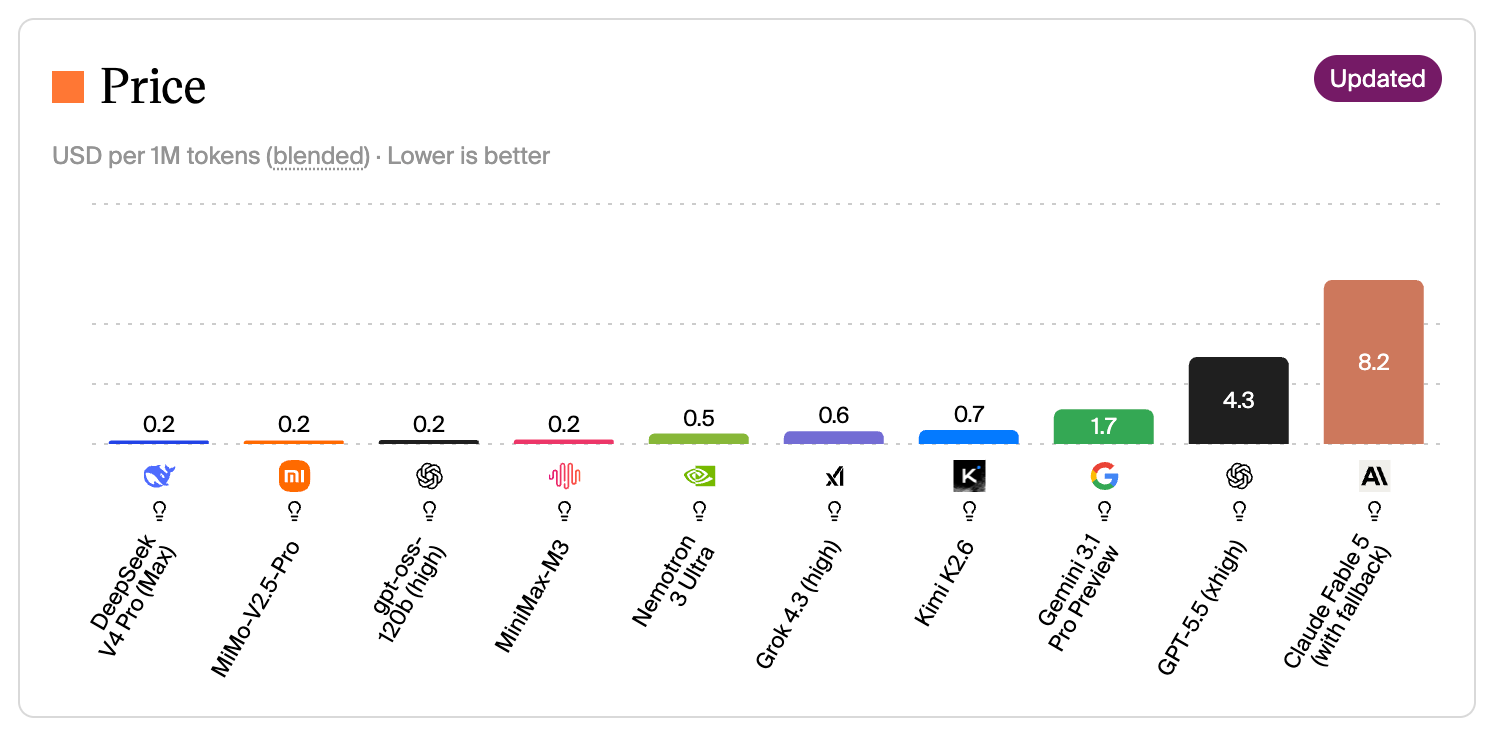
As of June 2026, Claude is also the most expensive model per token in the mainstream market — and Anthropic just stretched that lead. Its new flagship tier, Claude Fable 5, lists at $10 per million input tokens and $50 per million output — double the already-premium Opus 4.8, which runs about $5 and $25. Line that up against the field and it’s stark: Google’s Gemini 3.1 Pro is roughly $2/$12, OpenAI’s GPT-5.5 about $1.75/$14, Elon’s Grok as low as $0.20/$0.50 — and open-weight models like DeepSeek and Llama are effectively free, a few cents per million or self-hosted for nothing. Claude’s flagship output can cost roughly 4x Gemini’s, 100x Grok’s, and hundreds of times the open-source options. Anthropic is, consistently and now emphatically, the premium-priced choice — and it gets away with it because for the work people care about most, especially coding, Claude is simply the model they want. (Fable, for its part, is cheaper than the model it descends from: the restricted Mythos Preview cost more than twice as much. Even Anthropic’s price cuts arrive at the top of the market.)
You feel that premium as a user, too. It’s become a running joke that the moment Anthropic ships a new model, the top reply is someone saying they typed one prompt and hit their usage limit. Fable 5 made the subtext text: Anthropic shipped it free on paid plans for exactly two weeks, then announced that after June 23 you’d need to buy usage credits to keep going, because it couldn’t predict whether it had the capacity to give the model away. The caps are tight because the compute behind every answer is genuinely, structurally expensive. People grumble, and renew anyway.
Which points at something we’ve all quietly accepted. A few years ago, the average person paid nothing for software like this — it didn’t exist. When Adobe dragged its Creative Cloud onto a $20-to-$60-a-month subscription, users complained for years. Now? AI subscriptions opened at $20 a month, then $100, then $200 — ChatGPT Pro and Claude’s Max tier both top out around $200/month — and a $2,400-a-year bill for a chatbot has become unremarkable. We went from “I’d never pay for an app” to “of course I pay $200 a month for this” in roughly 24 months. That is one of the fastest jumps in consumer willingness-to-pay in the history of software, and a big reason the revenue is real rather than promotional.
And when something is this valuable and this restricted at once, a grey market appears. In China, where Claude isn’t officially available, an underground economy of “relay stations” has sprung up — proxy services that route developers to Claude and Gemini around the restrictions. On marketplaces like Taobao and Xianyu, sellers openly hawk “unlimited Claude Code” and no-VPN access to the full Claude suite; one vendor has filled more than 2,200 orders. People are buying frontier AI on the black market. That is what demand looks like when a product is good enough that price, usage caps, and even national restrictions become things to route around rather than reasons to stop.
The engine in reverse
Because here’s the catch. That $47 billion of revenue is being chased by a genuinely staggering amount of spending — and when you trace where Anthropic’s money comes from and where it goes, the line starts to bend into a circle.
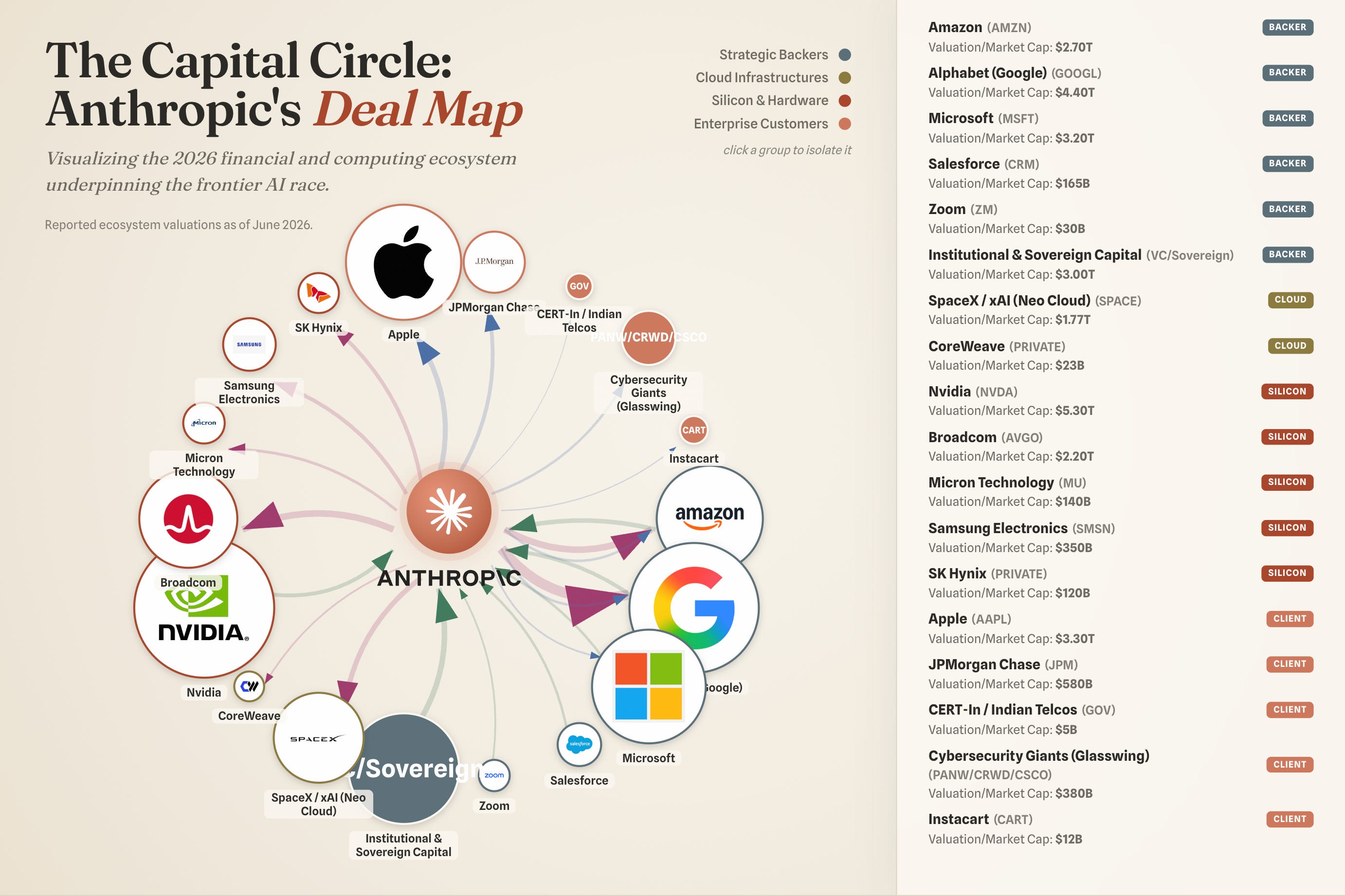
Watch the loop. Amazon has poured billions into Anthropic and is its primary cloud provider, so Anthropic’s revenue flows back to Amazon as cloud spend — and Amazon books a gain on its stake. (In the first quarter of 2026 alone, Amazon recorded $16.8 billion in paper gains on its Anthropic investment.) Google invests, and sells Anthropic its TPUs. Microsoft and Nvidia invest, and Anthropic commits to spending tens of billions on their compute. Nvidia sits under nearly all of it, selling the chips — and investing in the very labs that buy them.
Zoom out and the whole industry looks like this. Analysts have now tallied more than $800 billion in these crisscrossing arrangements: chipmakers and clouds investing in AI labs that spend the money right back on the investors’ chips and clouds. The cash circles a small handful of giants, and every lap makes demand look organic and revenue look robust. Critics have a less flattering term for it, borrowed from the dot-com bust — round-tripping.
Explore the interactive version →
Is it a scam? Not exactly. Dario Amodei has defended the structure head-on: one party has the capital and sells the chips, the other is confident it’ll have the revenue but doesn’t have $50 billion lying around, so they meet in the middle. “I don’t think there’s anything inappropriate about that in principle,” he said. He’s probably right that each deal is rational on its own. The open question — the one that gets its own installment later in this series — is whether the whole interlocking structure is as sturdy as it looks, or whether it only holds as long as everyone keeps spending.
The race to ring the bell
All of this is happening against a clock, because Anthropic is sprinting to the public markets.
Just four days after closing the Series H, Anthropic confidentially filed draft IPO paperwork with the SEC, reportedly targeting a listing around October 2026. It’s a three-way dash with OpenAI and Elon Musk’s SpaceX to stage the first trillion-dollar AI debut — the kind of clustering that, fairly or not, tends to mark the top of a cycle.
There’s even a political subplot. Earlier this year the Pentagon labeled Anthropic a “supply-chain risk” after it refused to let the military use Claude for surveillance and autonomous weapons. As the IPO nears, tensions with the White House are easing — Dario visited in April and the relationship has warmed — though the company is still suing the Defense Department over the designation. Even a company this dominant needs the government onside before it rings the bell.
The flywheel, and the bet
Step back, and the money story and the talent story from Part 1 turn out to be the same story.
The best team builds the best models. The best models win the enterprise. Enterprise revenue funds more compute. More compute and more capital attract more of the best team. Round and round — a real flywheel, each turn feeding the next. It is the most impressive engine in technology right now, and the numbers — $47 billion, $965 billion, 10x a year — are not fake.
To the skeptics, that circular shape is the warning: capital, compute, and revenue chasing one another in a loop that flatters everyone’s numbers until it doesn’t. I understand the worry. But I think it misreads what’s actually being financed. This isn’t a loop spinning in place — it’s an exponential, and exponentials look reckless right up until they look inevitable. The spending only seems irrational if you assume the models are about to plateau. I don’t think they are. We’re already watching AI accelerate the building of AI: Anthropic’s own engineers now ship many times the code they used to, the majority of it written by Claude, and the recursive loop Andrej Karpathy was hired to close has started to turn. If you believe, as I do, that we are on the path to something like AGI, then a billion dollars a month for compute isn’t evidence of a bubble. It’s the rational price of admission to the most valuable technology ever built — and the people and companies moving fastest are simply the ones who took that bet seriously, and early.
So no — I don’t think this is a fragile flywheel. I think it’s what the runway to AGI looks like from the inside, and it costs this much precisely because the prize is real.
But the whole argument rests on one load-bearing claim: that the models keep getting better, fast. Which points to the question underneath the valuation, the revenue, and the compute bills alike — not how much Anthropic is worth, but why Claude is this good in the first place. That’s where this series goes next.
Hold the image one more time: the most valuable startup on Earth, growing faster than anything before it, paying its fiercest competitor a billion dollars a month to keep the lights on. That’s not the posture of a company that thinks the music is about to stop. It’s a company sprinting toward a finish line it can already see.
Part 2 of a series. Next: Why Claude Is This Good — the research edge behind the best models in AI: benchmark dominance and Claude Code, Constitutional AI and the strange, serious work of giving a model a character, and the bet on recursive self-improvement.
Missed Part 1?