
All at One Company
How Anthropic quietly assembled the best team in AI — and why the best people in the field keep trading their titles to get there.

Part 1 of a series on how Anthropic went from underdog to the most important company in AI.
In May, Andrej Karpathy posted a personal update on X.
If you don’t know the name: Karpathy is a co-founder of OpenAI, the former Director of AI at Tesla, and probably the single most influential AI educator alive — the person who taught a generation of engineers how neural networks actually work, and who more recently coined the term “vibe coding”. He hasn’t bothered to update his LinkedIn since Tesla; X is where he talks to the field, and when he posts, the field reads. Here’s what he wrote:

The title attached to it was three letters: MTS. Member of Technical Staff. A senior individual-contributor role — no division to run, no thousand reports, no C-suite seat. One of the most accomplished people in the history of the field, choosing to get back to the keyboard.
That’s the part worth sitting with. Karpathy could have any title at any company on Earth. And he chose to be an IC.
And it didn’t come out of nowhere. Two months earlier, on the No Priors podcast in March 2026, Karpathy all but narrated the decision before he made it. Staying outside a frontier lab, he worried, would slowly dull his instincts — that his judgment would “inevitably start to drift,” because from the outside he wouldn’t truly grasp how these opaque, fast-moving systems work under the hood. The cure was proximity: getting his hands back on the work. Two months later, he did.
He is not the exception. He’s the pattern.
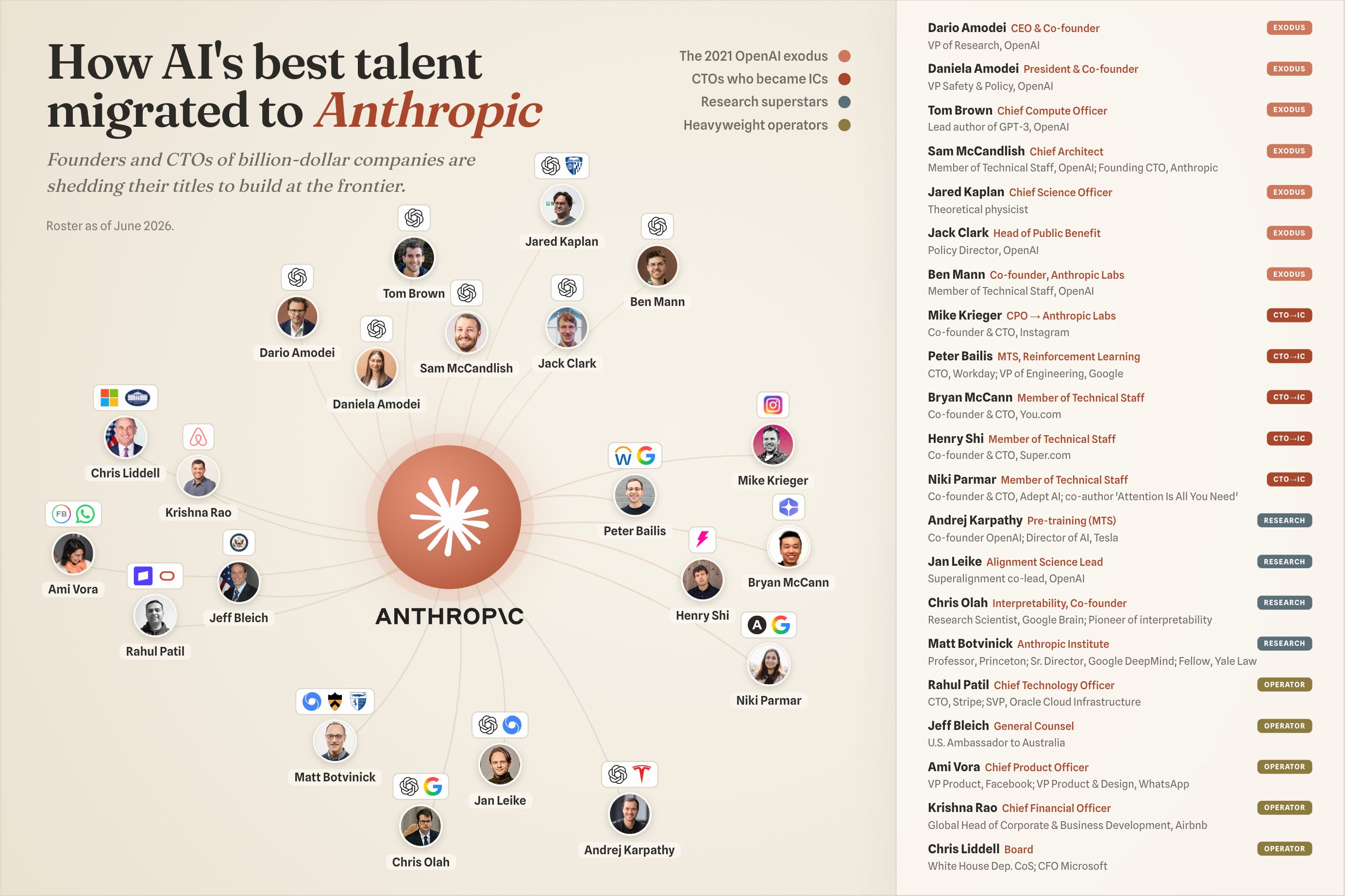
The migration, mapped. Explore the interactive version →
Map out where elite AI talent has gone over the past few years and you get something that looks less like normal hiring and more like a gravity well — a single point bending the whole field’s trajectory toward it. The people who wrote the foundational papers. The chief technologists of billion-dollar companies. The researchers who care most about AI safety. A former U.S. Ambassador. They keep landing in the same place, and many of them gave up a more senior title to do it.
This is a piece about why. Because talent density is the most honest leading indicator there is. Valuations can be financially engineered. Benchmarks can be gamed. But when people who could run anything choose, voluntarily, to give up the title and the team to go somewhere — they’re telling you where they believe the important work is. Right now, an unusual number of the best are telling you the same thing.
The Anthropic founders who walked away from OpenAI
Start at the origin, because the whole culture descends from it.
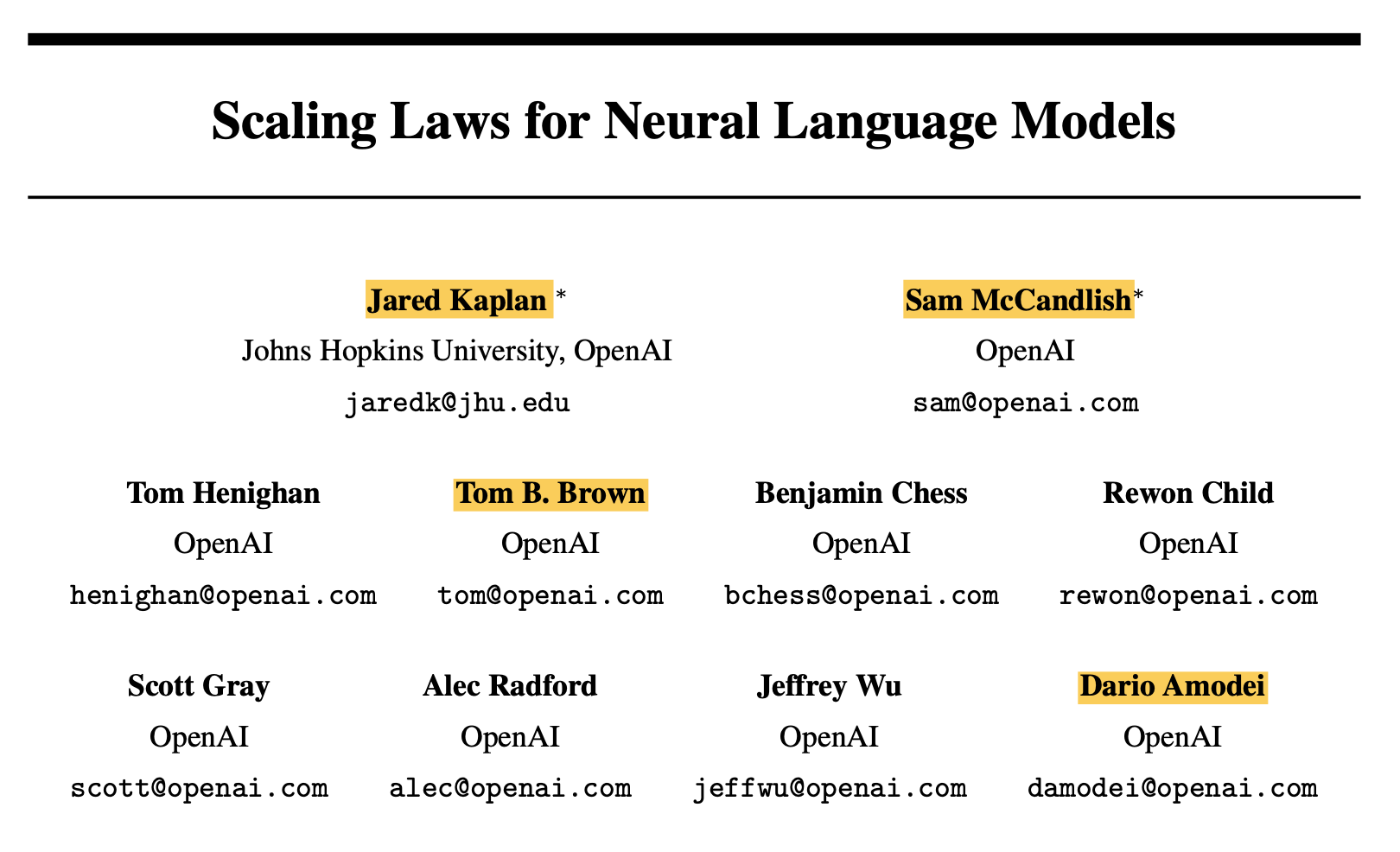
Anthropic was founded in 2021 by a tight group who left OpenAI together: siblings Dario and Daniela Amodei, Tom Brown, Sam McCandlish, Jared Kaplan, Jack Clark, Chris Olah, Ben Mann, and others. This was not a layer of mid-level staff walking out. Tom Brown was the lead author of the GPT-3 paper — the result that convinced the world large language models were going to matter. Jared Kaplan, a theoretical physicist, co-authored the scaling laws: the finding that models get predictably smarter as you add compute and data, which is the intellectual engine under the entire modern AI boom. Chris Olah pioneered mechanistic interpretability, the science of reverse-engineering what’s actually happening inside a neural network.
They didn’t leave over a scandal. They left over a disagreement about what the first people to build powerful AI owe the future. As OpenAI’s commercial entanglement with Microsoft deepened, this group concluded that safety couldn’t be a side team bolted onto a product org — it had to be the core engineering problem, co-located with the most advanced capabilities. So they left OpenAI to build a lab around that premise.
Two details from the founding still shape everything. The first is the sibling structure: Dario as CEO, Daniela as President — a brother-and-sister pair running a company now valued near a trillion dollars, which is essentially unheard of at this scale. The second is a phrase Dario has returned to ever since, most fully in his essay Machines of Loving Grace: the goal is to build a country of geniuses in a datacenter, and to do it carefully, before someone else does it carelessly. That sentence is the recruiting pitch. It turns out a specific kind of brilliant person finds it irresistible.
The status inversion
Here’s the phenomenon that should make you sit up, because it breaks the normal rules of tech careers.
The standard arrow of ambition points up: engineer to manager to director to VP to CTO. More scope, more reports, more title. At Anthropic, a remarkable number of people have run that arrow in reverse.
Mike Krieger co-founded and was CTO of Instagram; he joined as Chief Product Officer and moved into hands-on work co-leading Anthropic Labs. Bryan McCann stepped off the founder/CTO track at You.com to do frontline research. Henry Shi scaled Super.com past $200M in revenue as co-founder and CTO, then went IC.
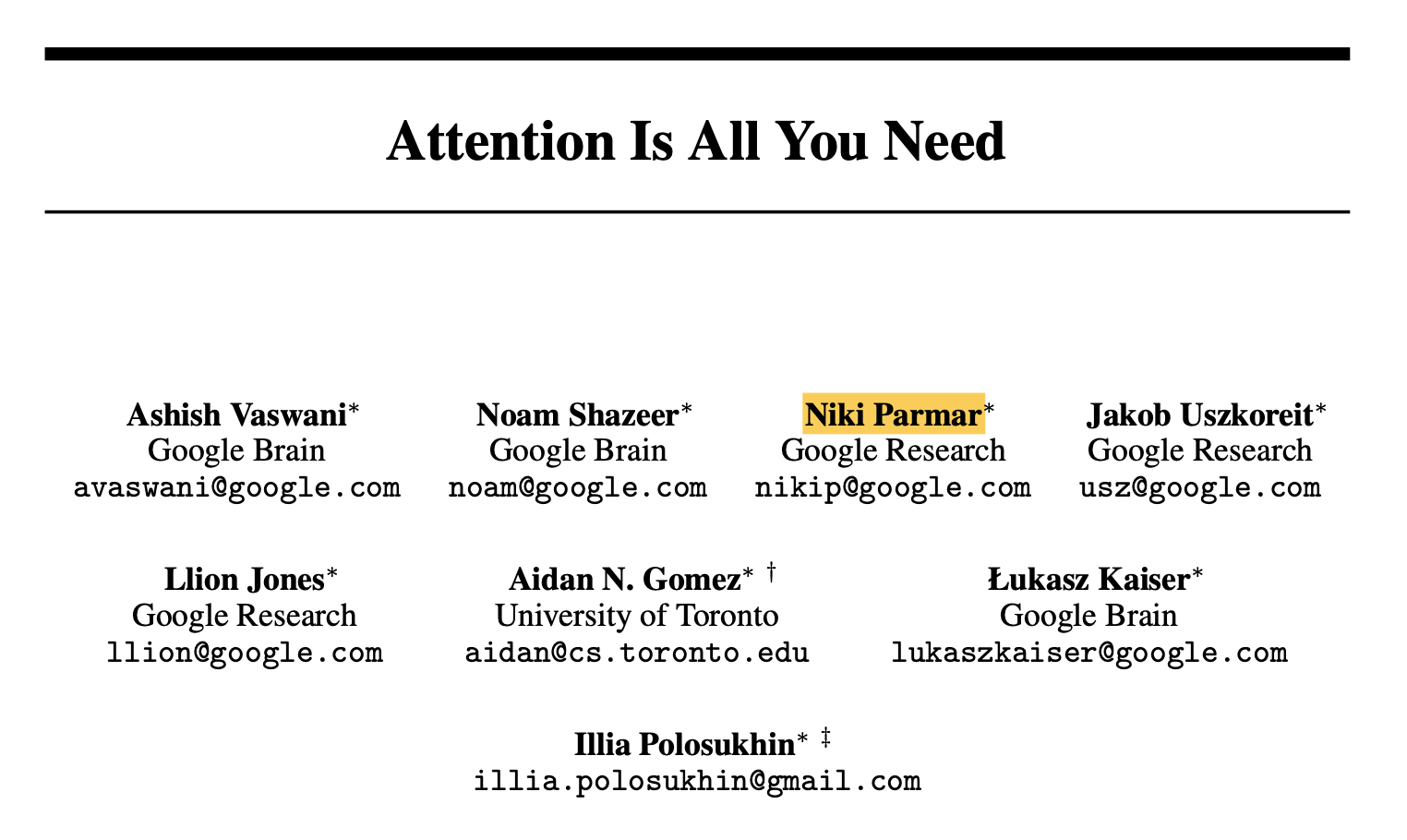
Consider Niki Parmar. She’s a co-author of “Attention Is All You Need,” the 2017 paper that introduced the Transformer — the architecture every modern model, including Claude and GPT, is built on. After Google, she co-founded two AI companies: Adept, which raised $415 million and reached a billion-dollar valuation, and Essential AI, which raised about $65 million from Google, NVIDIA, and AMD. She helped invent the foundation of the entire field and has been a founder twice over. She joined Anthropic as a Member of Technical Staff.
The cleanest example of the inversion, though, is Peter Bailis. He took the CTO job at Workday in May 2025, having previously been a VP of engineering at Google Cloud. Less than a year later he left — to join Anthropic as an MTS working on reinforcement-learning engineering, as Business Insider and others reported. A sitting CTO of a major public software company walked out of the C-suite for a role with no executive title at all. And here’s the kicker: Anthropic is now openly building the kind of enterprise HR software Workday sells, with job listings reportedly seeking candidates who know Workday, Salesforce, and NetSuite. He didn't just trade a title for proximity—he crossed the board to build the literal engine designed to cannibalize his old company.
Now, the obvious cynical read is that these people took pay cuts. They didn’t. “Member of Technical Staff” is not a junior title at a frontier lab — it’s the prestige track, and public H-1B filings put Anthropic MTS base salaries firmly in the mid-six figures—typically scaling from $300,000 to $405,000—and that’s before layering on equity in a company valued near a trillion dollars. So the trade isn’t title-for-money. It’s title-for-proximity. They gave up org charts and budgets, not paychecks.
Why make that trade at all? Because the scarce thing has changed. In the old tech hierarchy, power meant controlling headcount and budget. At the frontier of AI, what’s scarce is no longer the size of the organization you manage — it’s how close you are to the models, the data, and the ability to turn them into products. On that new axis, an IC with their hands on Claude has more leverage than a VP three layers removed from it. The title inversion isn’t a sacrifice these people are grudgingly making. It’s a preference they’re finally able to indulge, at the one place where being a builder is the high-status move.
The researchers and the gravity of ideas
The third cluster is the research talent, and here the pull is partly ideological.
Jan Leike co-led OpenAI’s superalignment team and resigned publicly, with a now-famous line about safety culture having taken a backseat to shiny products. He went to Anthropic to lead alignment science. Chris Olah anchors interpretability. Matt Botvinick — a Princeton professor and former senior research director at Google DeepMind — joined the new Anthropic Institute. And Karpathy joined the pre-training team with a mandate that sounds like science fiction and is stated plainly in Anthropic’s own materials: to build systems that use Claude to accelerate the research that builds the next Claude. The loop has a name — recursive self-improvement — and the fact that the person trusted to work on it chose Anthropic is itself a data point about where the serious people think the serious work is.
And the loop is no longer purely hypothetical. This month, just weeks after Karpathy arrived, the Anthropic Institute published When AI builds itself, reporting that AI is already measurably accelerating its own development: the company’s engineers now ship roughly 8x as much code per quarter as they did a few years ago, the large majority of it written by Claude. Anthropic was careful to say full recursive self-improvement isn’t here and isn’t inevitable, and skeptics counter that this is still just faster coding under human supervision. But it’s a striking thing to publish in the same season you hire the one person whose explicit mandate is to close that loop.
There’s a flywheel here that’s easy to miss. Researchers who care most about alignment cluster where alignment is treated as foundational rather than as a compliance function. That concentration of safety talent then becomes a recruiting magnet for more safety talent, because the best people want to work with the best people on the problem they think actually matters. Mission, in other words, compounds.
The operators nobody talks about
This is the layer most people overlook, and it might be the most telling.
A research lab full of geniuses is a research lab. A company that ships products, survives geopolitics, and raises tens of billions needs a different kind of talent — and Anthropic went and got the best of that too. Rahul Patil, formerly CTO of Stripe and an SVP at Oracle Cloud, runs engineering as CTO. Ami Vora, who led product at WhatsApp and Facebook, is Chief Product Officer. Krishna Rao came from Airbnb to be CFO. Chris Liddell, former CFO of Microsoft and White House Deputy Chief of Staff, sits on the board. And Jeff Bleich — a former U.S. Ambassador to Australia and special counsel to a sitting president — is General Counsel.
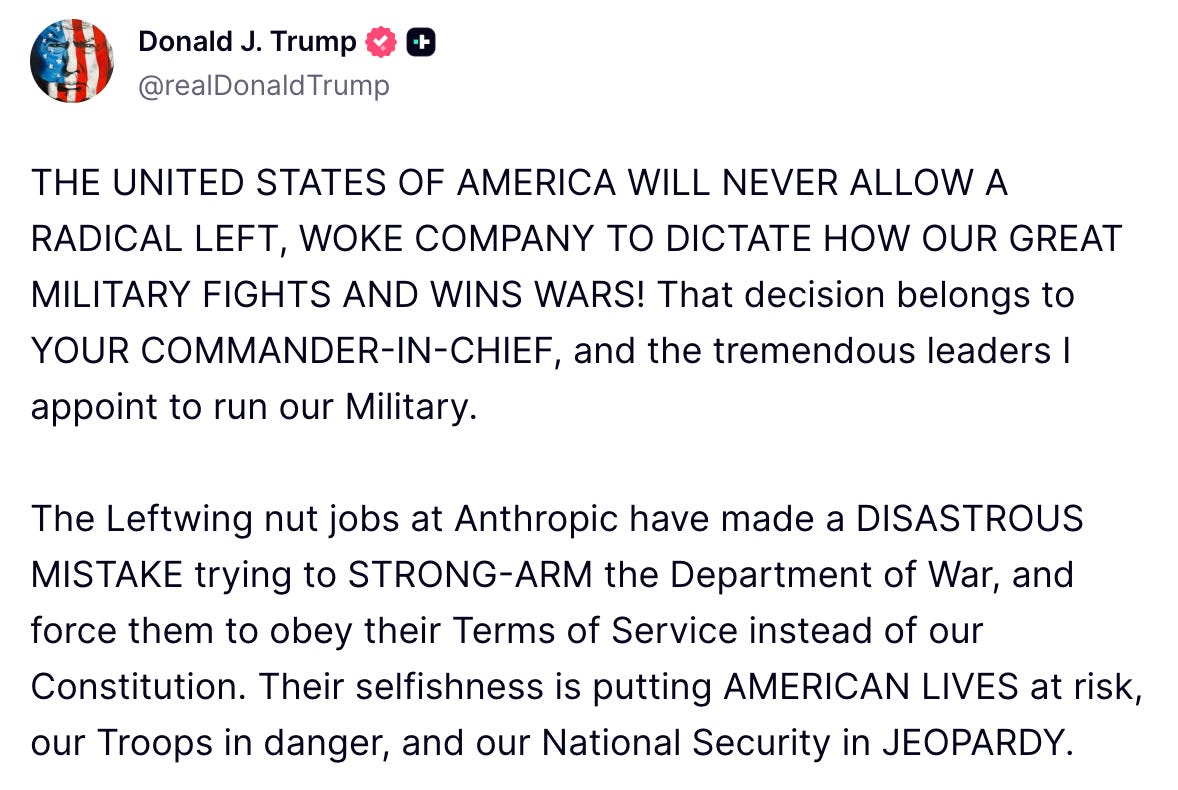
Why does a frontier lab need a diplomat? Because the questions facing Anthropic are no longer just technical. In March 2026, the Pentagon designated Anthropic a “supply-chain risk” — the first time a U.S. company had ever received a label normally reserved for firms tied to adversarial nations — after it refused to let the military use Claude for domestic surveillance and autonomous weapons, and the company is now suing the Department of Defense over it. When your fights are about gigawatt-scale power for datacenters, sovereign-cloud deployments, and what a national security council will and won’t let you build, you don’t need a growth lawyer — you need a diplomat. The presence of an ambassador-grade operator on the legal team tells you the company understands it is now operating at the altitude of states, not just startups. The operators are the difference between a brilliant research project and an institution that lasts.
Why money isn’t the variable: the Meta contrast
Here’s the cleanest way to prove the point. If elite talent were simply for sale, Mark Zuckerberg would have bought all of it. He tried.
In 2025, Meta launched an all-out blitz to build a “Superintelligence” lab. It paid roughly $14.3 billion for a 49% stake in Scale AI, largely to install that company’s founder, Alexandr Wang, atop the new team. Sam Altman said Meta dangled “$100 million signing bonuses” and richer annual comp at OpenAI’s researchers. At Mira Murati’s startup Thinking Machines Lab, Meta reportedly approached more than a dozen people — and offered one person over $1 billion across several years.
And it kept not working on the people who mattered most. Altman said that, at least early on, none of his best people had taken the offers. Not a single person at Thinking Machines accepted — including the one offered more than a billion dollars. One researcher reportedly turned down an $18 million Meta offer to join Murati’s startup instead. Meta won plenty of hires with the checkbook — it is a $1.8 trillion company and the money is real — but the pattern of the most-wanted people declining sums that would alter a family’s wealth for generations is the tell. Harvard Business School even turned the spree into a case study, asking whether a team assembled this way would actually function.
Now hold that against Anthropic. Anthropic is not winning a bidding war; in many cases it isn’t even the highest bidder. Its people are taking smaller titles, and they aren’t being pried loose with billion-dollar packages — they’re walking in the door. That’s the entire distinction, and it’s the difference between push and pull. Meta is trying to buy a team. Anthropic is attracting one. Money can move a mercenary; it struggles to move a believer who is already where they want to be. When the scarce resource is conviction — in the mission, in the problem, in the people already inside the building — you cannot simply outbid for it.
So what is Anthropic actually doing?
There’s a name for it, and it comes from the management literature, not the tech press. Harvard Business School’s Boris Groysberg calls it talent density — the ratio of exceptionally talented people to total headcount. His argument is that AI lets organizations stay small while becoming vastly more productive, which flips the old growth playbook: instead of hiring thousands, you obsess over concentrating stars in the roles that matter most. Anthropic is that thesis taken to its logical extreme, and it works for four reasons.
Mission selects for true believers. The safety thesis isn’t a marketing layer; it’s a worldview, and it filters hard. People who share it would rather build it here than build something faster somewhere else.
Compute makes the work possible. You cannot do frontier research without enormous compute, and Anthropic has gone to extraordinary lengths to secure it. Beyond its Amazon and Google backing, it agreed to pay Elon Musk’s xAI $1.25 billion every month through 2029 — for the entire output of a single data center near Memphis — a deal that only came to light through SpaceX’s IPO filing. When a company will cut a $1.25-billion-a-month check to one of its fiercest rivals just to keep its experiments running, compute isn’t a line item; it’s oxygen. And talent follows the oxygen.
$1,250,000,000
The monthly check Anthropic agreed to pay rival xAI through 2029 just to secure the compute output of a single Memphis data center.
The recursive loop is the most exciting problem in the field. Karpathy’s mandate — using the model to improve the model — is, if it works, the steepest part of the entire curve. Ambitious researchers want to be standing exactly there when it bends.
The culture rewards the builder. At most companies, going back to the keyboard is a step down. At Anthropic it’s the prestige path — the one cultural fact that unlocks a category of hire almost no one else can recruit.
The honest part
Mythology is fun; credibility is better. So: Anthropic does not have the only great team in AI, and anyone telling you otherwise is selling something. Google DeepMind is one of the deepest benches in the history of the field. OpenAI, even through its turbulence, retains extraordinary people and ships extraordinary things. Meta is spending more than anyone and may yet assemble something formidable.
And there’s a deeper caution worth naming — one that comes from the same scholar who coined the talent-density framing. Groysberg’s best-known book, Chasing Stars, is built on years of evidence that star talent often doesn’t transfer between organizations: take a brilliant performer out of the system that made them brilliant, and performance frequently craters, because so much of it was never portable in the first place. That’s the real risk hiding under a roster this glittering — and, notably, it’s the same risk hanging over Meta’s checkbook strategy. A list of famous names is not a team. But Anthropic has a structural defense against the curse: focus. At a legacy tech giant, stars get scattered across competing product silos, each building a separate empire on a different roadmap. Anthropic’s talent is pointed at a single, unified engine — Claude. They aren’t importing isolated stars to run their own fiefdoms; they’re being plugged into one collaborative machine, with a shared mission, shared tools, and a shared problem. That’s the bet — and it is a bet. If it’s right, the density compounds. If it’s wrong, it’s an expensive collection of résumés. Talent density is necessary, not sufficient; execution, the brutal economics of compute, and the open question of whether this entire AI cycle is partly a bubble all still loom over the story.
But on the narrow, specific question — where are the most accomplished people in AI choosing to go, right now, and what are they willing to give up to get there — the answer keeps coming back the same. Not the biggest title. Not the biggest check. One company, one mission, and a willingness to be a builder again.
Here’s the reframe I’ll leave you with. We talk about Anthropic’s ~$965 billion valuation as if it’s a story about Claude — about model quality, benchmark wins, enterprise contracts. But underneath, it’s a story about people. The market is partly pricing in a simple, radical fact: the smartest people in the world have decided that being an individual contributor at Anthropic is more impactful than being a CTO almost anywhere else — or, in Meta’s case, than being a billionaire almost anywhere else. The best team builds the best models; the best models attract the best team; the gap compounds.
Six CTOs. The lead author of GPT-3. A co-author of the Transformer. OpenAI’s former alignment chief. A former U.S. Ambassador.
All at one company.
This is Part 1 of a series. Next: The Money — how Anthropic blew past OpenAI’s valuation, why companies are burning hundreds of millions of dollars “tokenmaxxing,” and what the race to IPO reveals about the whole AI economy.
Explore the interactive talent map: shashu10.github.io/anthropic-talent-migration